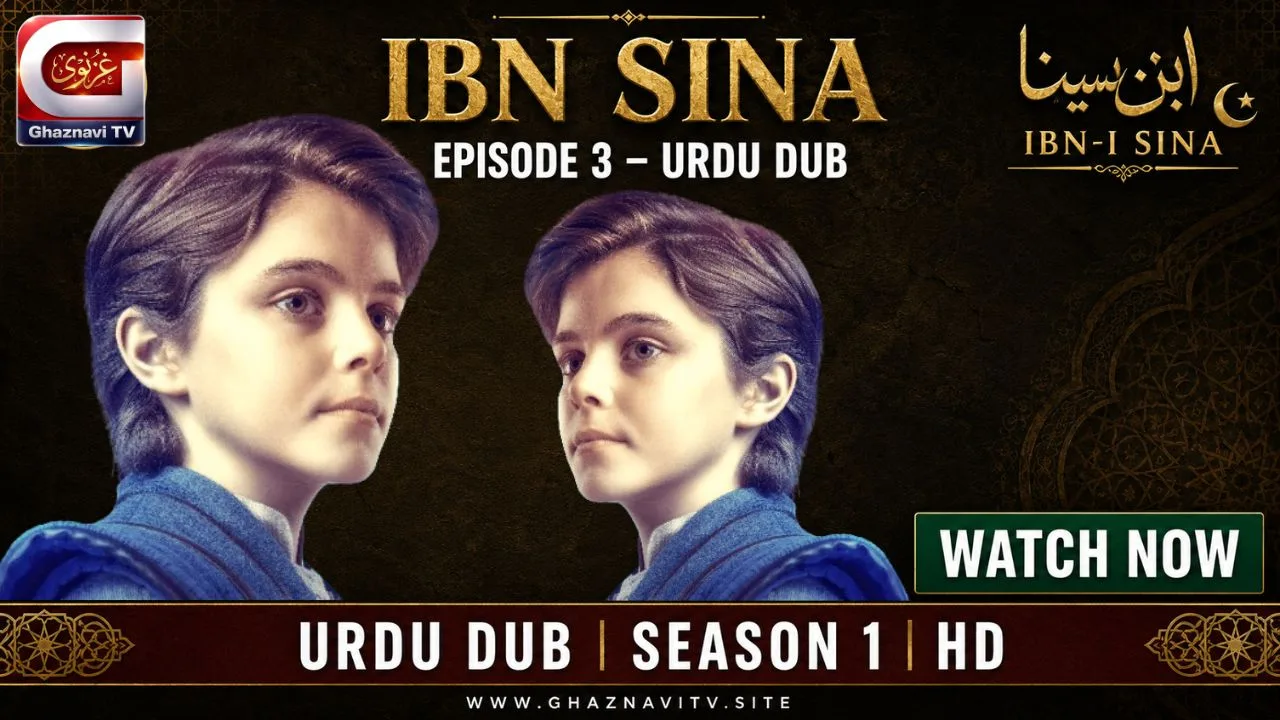

Ibn Sina Episode 3 Urdu Dub is now streaming free on Ghaznavi TV. By the third episode, something has shifted. The character we are watching is no longer simply curious — he is becoming something more specific. His questions have found a direction. His observations are developing a pattern. And the world around him is beginning to realize that this particular child is not going to fit neatly into any existing category of what a child is supposed to be.
Watch Ibn Sina Episode 3 Urdu Dub

For Download Please Scroll on bottom👇
Why Ibn Sina Episode 3 Urdu Dub Marks a Real Turning Point in Young Sina’s Journey
There is a particular moment in the development of any gifted child — not a dramatic moment, not a single event — when curiosity stops being a random impulse and starts becoming something more deliberate. Something with direction. Ibn Sina Episode 3 Urdu Dub captures that moment in young Sina’s life with the kind of quiet precision that makes the episode genuinely moving without ever being sentimental about it.
TABLE Of CONTENT
Table of Contents
Episodes 1 and 2 showed us a child who noticed everything and questioned everything — whose mind was essentially a wide net being cast in every direction at once. Episode 3 begins to show us something more interesting: a child who is starting to understand not just individual things, but how individual things relate to each other. Who is beginning to build a framework rather than just collecting observations. Who is, in other words, starting to think like the person history will eventually call one of the greatest scientific and philosophical minds of the medieval world.
The Episode That Shows the Method Forming
What Ibn Sina Episode 3 Urdu Dub does particularly well is show the development of what we would now call a scientific method — but shown not as a formal intellectual achievement, but as the natural result of how this specific child’s mind has always worked. He observes first. He resists jumping to conclusions. He tests his early ideas against new evidence before committing to them. And when new evidence conflicts with what he thought he understood, he changes his thinking rather than ignoring the evidence.

These habits of mind did not come from a textbook. They came from a temperament — from the specific way young Sina has been engaging with the world since he was old enough to start engaging with it at all. Episode 3 shows us these habits operating in a new context, and in doing so, shows us exactly why they matter.
A Series That Respects Its Audience’s Intelligence
One of the most refreshing qualities that Ibn Sina Episode 3 Urdu Dub — available on Ghaznavi TV — shares with the best educational drama is its respect for the intelligence of its viewers. It does not simplify young Sina’s thinking into easy tricks or convenient moments of genius. It shows thinking as the slow, sometimes frustrated, always earnest process that it actually is. And in doing so, it gives young viewers something genuinely valuable: a model of what real intellectual effort looks like from the inside.
How Episode 3 Builds on What Episodes 1 and 2 Established
Viewers who have been watching from the beginning will notice in Ibn Sina Episode 3 Urdu Dub that the seeds planted in the first two episodes are now beginning to produce something visible. The relationships established earlier — with his parents, his teachers, and the community around him — have deepened enough to carry real weight. The intellectual interests introduced in Episode 1 have developed enough to show genuine direction. And the character of young Sina himself has become specific enough that his reactions and choices feel genuinely his, rather than generically those of a gifted child.
A Hunger for Knowledge That Grows Larger With Every Answer It Receives
One of the specific qualities that Ibn Sina Episode 3 Urdu Dub depicts with particular accuracy is the paradoxical nature of genuine intellectual curiosity: the more answers it receives, the more questions it generates. For most people, learning reduces uncertainty. For young Sina, learning expands it — not in a distressing way, but in the most productive possible way. Every answer he receives reveals three questions he had not previously thought to ask.
This quality — which might frustrate teachers who expect learning to be a linear process of filling gaps — is actually the defining characteristic of the kind of mind that produces original knowledge rather than simply accumulating existing knowledge. Episode 3 shows this quality in action through specific scenes where Sina receives information that satisfies one question and immediately generates another, deeper one — and where the people around him must decide whether to follow him into that deeper question or to redirect him toward more conventional learning.
The Subjects That Absorb Him Most Completely in Episode 3
By the third episode, patterns in young Sina’s intellectual interests have become visible. He is drawn most strongly to questions about how things work rather than simply what things are. He wants to understand mechanisms — the reasons behind effects, the causes behind symptoms, the principles behind observations. This orientation toward mechanism and causation is what will eventually make him such a revolutionary figure in medicine: rather than simply cataloguing treatments that seem to work, he will ask why they work — and that question will unlock entirely new levels of medical understanding.
In Ibn Sina Episode 3 Urdu Dub, we see this orientation operating in age-appropriate ways — through puzzles, through observations of the natural world, through questions about illness and health that his teachers find simultaneously impressive and challenging to answer fully.
What It Feels Like to Be a Child Whose Mind Never Rests
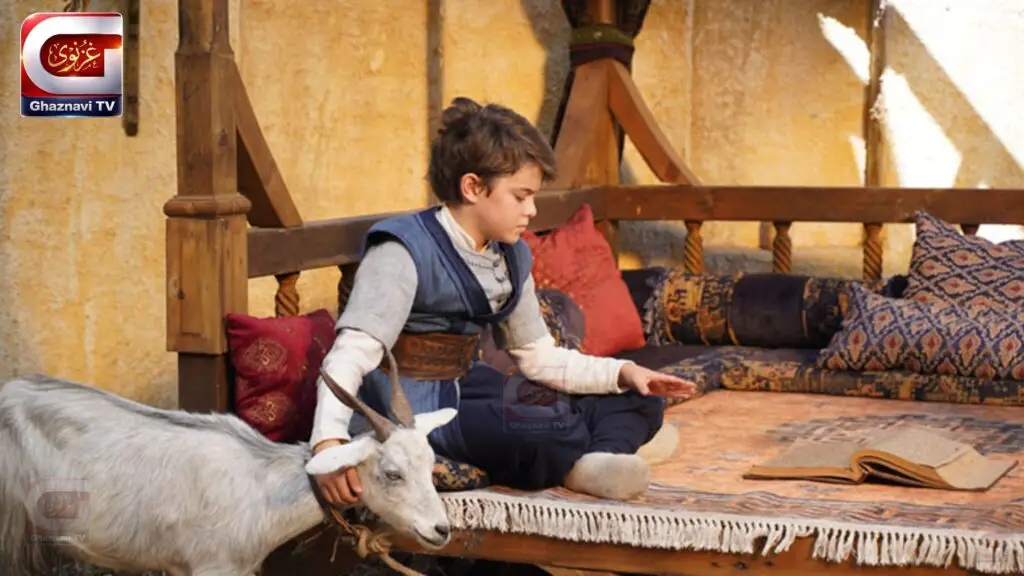
The series does something genuinely thoughtful in Episode 3 that many similar productions miss: it shows the personal experience of having a mind like Sina’s from the inside. Not just the impressive results of that mind, but the actual texture of living with it. The restlessness. The difficulty of turning the questions off when the day is supposed to be done. The slight social awkwardness that comes from caring intensely about things that the people around you are not particularly interested in.
These qualities are depicted without drama and without self-pity — simply as the honest realities of this particular child’s experience. And in depicting them honestly, the series creates a character who feels genuinely real rather than idealized.
Why This Portrayal Matters for Young Viewers
For children watching Ibn Sina Episode 3 Urdu Dub on Ghaznavi TV who recognize something of their own experience in young Sina — the restless curiosity, the questions that never stop, the feeling of caring about things other people find strange — this episode offers something quietly powerful: the reassurance that these qualities are not problems to be managed, but gifts to be developed. The child who cannot stop asking questions is not difficult. That child is, potentially, extraordinary.
The Quran, Philosophy, and Science – How He Holds All Three Together Without Contradiction
One of the most intellectually interesting aspects of Ibn Sina Episode 3 Urdu Dub is the way it portrays young Sina’s relationship to the three great domains of knowledge he is simultaneously pursuing: Quranic study, philosophical reasoning, and early scientific investigation. In many portrayals of historical scholars, these three domains are kept somewhat separate — as if the person moved between them rather than integrating them. The series takes a more accurate and more interesting approach: it shows young Sina experiencing them as parts of a single unified pursuit of truth.

For him, the Quran is not in competition with philosophy or science. It is the foundation on which both rest — the source of the fundamental conviction that the universe is ordered, comprehensible, and worth understanding, because it was created by an intelligence infinitely greater than his own. Philosophy provides the tools for thinking about that universe clearly. Science provides the methods for investigating it empirically. All three work together, and the series shows this integration happening naturally in how he moves between subjects and how he connects what he learns in one domain to what he is discovering in another.
Faith That Sharpens Rather Than Limits Inquiry
The specific relationship between faith and inquiry that Ibn Sina Episode 3 Urdu Dub depicts is one of the episode’s most valuable contributions to the ongoing conversation about Islamic intellectual history. It is a common misconception — particularly in contemporary discourse — that faith and scientific inquiry are inherently in tension, and that the Islamic Golden Age happened despite Islamic faith rather than partly because of it.
The series corrects this misconception simply by depicting the reality accurately. For young Sina, and for the tradition of Islamic scholarship he is entering, the command to seek knowledge is itself a religious obligation. The Quran explicitly encourages reflection on the natural world. The conviction that the universe follows consistent, discoverable laws comes directly from the belief that it was created by a consistent, rational God. Faith, in this context, does not constrain inquiry. It motivates it.
The Philosophical Training That Gives His Science Its Precision
Episode 3 also gives meaningful attention to young Sina’s engagement with logic and philosophy — and specifically to how this philosophical training shapes the quality of his scientific thinking. Logic teaches him not just what to conclude but how to evaluate whether a conclusion is actually warranted. It teaches him the difference between an observation that suggests something and an observation that actually proves it. It teaches him to question his own reasoning as rigorously as he questions the world around him.

This integration of philosophical rigor with empirical observation is what will eventually make the historical Ibn Sina’s medical writing so distinctive — and so durably valuable. Episode 3 plants the seeds of this integration in the specific way it shows him using philosophical tools to evaluate his own scientific observations.
What This Tells Us About the Islamic Golden Age’s Intellectual Foundation
The picture of intellectual life that Ibn Sina Episode 3 Urdu Dub paints is historically accurate in a way that matters beyond its entertainment value. The Islamic Golden Age — the period roughly from the 8th to the 13th century CE during which Islamic civilization produced extraordinary advances in medicine, mathematics, astronomy, philosophy, and dozens of other fields — was possible precisely because of the integrated approach to knowledge that the series depicts. Faith, philosophy, and empirical investigation were understood not as competing domains but as complementary ones. Understanding this integration is essential to understanding why the Golden Age happened at all.
The New Challenge Episode 3 Places Before Young Sina
Every episode of Ibn-i Sina: The Young Genius gives its central character a specific problem to engage with — and Ibn Sina Episode 3 Urdu Dub is no exception. The challenge in Episode 3 is chosen with the same care and narrative intelligence that characterizes the series as a whole: it is the right level of difficulty for where young Sina is in his development, it connects to multiple areas of his growing knowledge simultaneously, and it produces insights that feel genuinely earned rather than convenient.
The specific nature of the challenge in Episode 3 — without describing it in a way that removes the pleasure of discovering it yourself — involves a situation that resists simple explanation and requires young Sina to draw on several different areas of knowledge and observation simultaneously. It is not solved through a single flash of inspiration. It is solved through the patient application of exactly the intellectual habits that the series has been building in him across the previous two episodes.
Why These Challenges Are Designed the Way They Are
The problems that young Sina faces in each episode of this series are not simply plot devices for demonstrating how intelligent he is. They are carefully constructed learning experiences — situations that reveal something about how a great mind actually operates, and that show young viewers what the process of genuine problem-solving looks like in practice.
In Ibn Sina Episode 3 Urdu Dub, the challenge is structured so that an intelligent but impatient approach — jumping to the most obvious conclusion — would produce a wrong answer. The correct solution requires slowing down, gathering more information before concluding, and being willing to revise an initial impression when new evidence suggests it was incomplete. These are not just intellectual habits. They are life skills — and the episode teaches them through story rather than instruction, which is the only way they actually stick.
The Moment When the Solution Arrives
One of the things the series consistently gets right about the experience of genuine problem-solving is the way solutions actually arrive — not in a single blinding moment of clarity, but gradually, as separate pieces of understanding finally assemble themselves into a complete picture. The solution moment in Ibn Sina Episode 3 Urdu Dub is satisfying precisely because it does not feel like magic. It feels like the inevitable result of everything that came before it — of all the observations made, all the questions asked, all the partial understandings that were held patiently until they found their place.
What Each Episode’s Challenge Adds to the Series Arc
The individual challenges across Season 1 are not isolated incidents — they are steps in a cumulative journey. Each one stretches young Sina a little further than the last. Each one requires him to draw on what previous challenges taught him while adding something genuinely new. By Episode 3, this cumulative effect is already visible: his approach to the current challenge is noticeably more sophisticated than his approach to the challenges in Episodes 1 and 2, and the series earns this sophistication by showing us exactly how it was developed.
How He Actually Thinks – Observation Before Conclusion, Always
If there is a single intellectual habit that Ibn Sina Episode 3 Urdu Dub depicts most consistently and most valuably, it is this: young Sina never concludes before he has observed. No matter how strong his initial impression, no matter how confident he feels about an initial reading of a situation, he insists on gathering more information before committing to a position. And he insists on this discipline even when — especially when — the people around him are ready to accept a more convenient and immediate answer.
This habit is harder to maintain than it sounds. There is a real psychological pressure, in any situation requiring a decision, to accept the first explanation that seems adequate and move on. The human mind is fundamentally an efficiency engine — it prefers good-enough answers delivered quickly to perfect answers delivered slowly. Resisting this pressure, choosing the slower and more demanding path of continued observation even when a quick answer is available, requires a specific kind of intellectual discipline that most people never fully develop.
The Difference Between Intelligence and Wisdom in Problem-Solving
One of the subtler distinctions that Ibn Sina Episode 3 Urdu Dub begins to draw — a distinction that will become more explicit in later episodes — is the difference between raw intelligence and something closer to wisdom in how problems are approached. Raw intelligence can generate answers quickly. Wisdom knows which questions to ask before generating answers. Raw intelligence finds the most efficient path to a solution. Wisdom makes sure it is actually solving the right problem before investing in a solution.
Young Sina in Episode 3 is operating at the intersection of these two qualities. His intelligence is already clearly exceptional. But what Episode 3 shows developing is the beginning of the wisdom that will eventually make him not just brilliant but genuinely great — the capacity to slow his own considerable mind down when slowness is what the situation actually requires.
Learning From Wrong Answers as Much as Right Ones
Episode 3 includes a moment that is rare in stories about gifted children: young Sina gets something wrong. Not catastrophically wrong. Not in a way that causes serious harm. But wrong enough that he must stop, recognize the error, and adjust his thinking. This moment is handled by the series with exactly the right touch — not as a failure to be dramatic about, and not as a trivial mistake to wave away quickly, but as a normal part of the learning process that a person of genuine intellectual integrity acknowledges and works through.
For young viewers watching Ibn Sina Episode 3 Urdu Dub, this is one of the episode’s most important gifts. It communicates that being wrong sometimes is not evidence of insufficient intelligence. It is evidence that you are actually trying — actually engaging with genuinely difficult questions rather than only attempting the ones you are already certain about.
The Role of Patience in His Particular Kind of Genius
What Episode 3 ultimately demonstrates about young Sina’s intelligence is that its most important component is not raw speed or extraordinary memory — though he clearly has both. It is patience. The willingness to stay with a question longer than is comfortable. To resist the pull toward a convenient answer. To remain genuinely uncertain until the evidence actually justifies certainty. This kind of patience is rarer than brilliance, and in the long run, it is more valuable. And Ibn Sina Episode 3 Urdu Dub shows it operating beautifully.
The Ethics He Practices, Not Just Learns About
A dimension of young Sina’s character that Ibn Sina Episode 3 Urdu Dub develops with particular care is his ethical sensibility — and specifically, the way his ethical commitments translate directly into how he acts in specific situations rather than simply remaining as abstract principles he has been taught to recite.
He tells the truth in Episode 3 when a comfortable version of the truth would have been much easier. He chooses to help someone whose problem is genuinely difficult when stepping aside would have been perfectly defensible. He takes responsibility for a mistake clearly and directly, without the elaborate self-justifications that most people — children and adults alike — instinctively reach for when something goes wrong. These are not dramatic moral heroics. They are small, specific choices — and they are more revealing of genuine character than any grand gesture could be.
Fairness as a Principle He Applies to Himself as Well as Others
One of the specific moral qualities that makes young Sina’s ethics compelling in Episode 3 is that he applies his standards of fairness to himself as rigorously as he applies them to others. He does not create convenient exceptions for his own convenience. When his own interest conflicts with what he believes is right, he chooses what is right — not dramatically, not with apparent struggle, but simply because that is how he is built.
This self-consistency is one of the rarest and most admirable forms of moral courage — and the series depicts it as something that has been developed through practice rather than gifted at birth. The ethical habits young Sina demonstrates in Episode 3 are the result of the values his parents and teachers have consistently modeled, and the reflection he has done about those values in the context of his own experience.
How His Desire to Help People Shapes His Direction
By Episode 3, it is becoming clear that young Sina’s intellectual interests and his ethical commitments are not separate tracks running in parallel. They are converging. His growing fascination with medicine and the human body is not simply intellectual curiosity. It is connected to a genuine desire to reduce suffering — to take what he understands about how the body works and use it to help people who are sick or in pain.
This connection between knowledge and service — between understanding and care — is one of the most important things the series communicates about what made the historical Ibn Sina remarkable. He was not simply a brilliant thinker who happened to work in medicine. He was someone for whom the purpose of understanding was always, fundamentally, to improve the lives of real people. Ibn Sina Episode 3 Urdu Dub shows this purpose beginning to form with quiet but genuine conviction.
What His Ethics Teach Young Viewers
For children and teenagers watching Ibn Sina Episode 3 Urdu Dub on Ghaznavi TV, the ethical dimension of young Sina’s character offers something that intellectual brilliance alone cannot: a model of what it looks like when intelligence is directed by genuine values. Brilliant people who lack ethical grounding can do tremendous damage. Brilliant people guided by genuine fairness, honesty, and care for others can change the world for the better. Episode 3 makes this distinction visible through specific action rather than abstract statement — which is the only way it actually means anything to a young audience.
His Father’s Investment in a Son He Cannot Fully Follow
Among the supporting characters in Ibn Sina Episode 3 Urdu Dub, young Sina’s father continues to be one of the most quietly compelling. He is a man of genuine learning himself — educated, thoughtful, and deeply committed to knowledge as a value. But his son has moved into intellectual territory that his own education did not map. And his response to this situation — not resentment, not defensiveness, but active investment in finding resources that can actually meet his son where he is — is one of the most admirable things the series shows.
By Episode 3, the father has become something more than a parent managing an exceptional child. He has become a genuine collaborator in young Sina’s education — someone who has accepted that his role is not to teach his son everything but to ensure that his son has access to everything he needs to teach himself. This shift in understanding, from parent as teacher to parent as facilitator, is one of the most honest portrayals of exceptional parenting that the series offers.
The Emotional Reality of Raising a Child Who Grows Beyond You
Episode 3 acknowledges, without making a drama of it, the specific emotional complexity of raising a child who is developing faster intellectually than the parent can fully track. There is pride in it — unmistakable, genuine pride. But there is also something quieter: the recognition that the child you are raising is becoming something you did not entirely create, moving toward a destination you cannot fully see.
Young Sina’s father carries this recognition with dignity in Episode 3. He does not try to slow his son down. He does not try to redirect him toward something more manageable. He simply does what a great parent does: he shows up, pays attention, and continues making decisions in his son’s best interest even when those decisions require him to admit the limits of his own knowledge.
What His Father’s Character Tells Us About the Environment That Made Ibn Sina Possible
The historical Ibn Sina’s extraordinary development was not accidental. It happened because the specific environment of his early life — the city of Bukhara during the height of the Samanid period, with its culture of intellectual seriousness and its access to genuinely excellent scholars — was exceptionally well-suited to nurturing exactly the kind of mind he had. His father’s role in connecting him to that environment was critical. Ibn Sina Episode 3 Urdu Dub honors this history by showing the father’s choices as genuinely consequential — not as background decoration but as active ingredients in who young Sina is becoming.
The Teachers Who Keep Discovering They Have More to Give
By Ibn Sina Episode 3 Urdu Dub, the teachers in young Sina’s life have settled into a relationship with their remarkable student that is genuinely different from what most of them have experienced before. They have passed the initial stage of simply being impressed. They are now in the more interesting and more demanding stage of actually being stretched by him — of finding that their best teaching, delivered to this particular student, produces questions they had not anticipated and leads the lesson in directions they had not planned.
For most teachers, this experience is either threatening or invigorating — and the series shows it being invigorating, which reflects well on the specific scholars young Sina has access to in Bukhara. These are people who got into the work of teaching because they love knowledge — which means that a student who pushes the edges of their knowledge is, for them, a source of genuine excitement rather than embarrassment.
The Teacher Who Gives Young Sina His Most Challenging Assignment Yet
Episode 3 features a specific teacher — one of the scholars his father has arranged access to — who responds to young Sina’s growing sophistication by giving him an assignment that is deliberately beyond what he could complete comfortably with his current knowledge. The assignment is not designed to frustrate him. It is designed to show him exactly where the edge of his current understanding lies, so that he can see clearly what he still needs to learn.
This kind of teaching — calibrated to the specific frontier of a specific student’s knowledge — is one of the highest forms of the craft. It requires knowing the student well, having a precise sense of where their genuine limits are, and trusting them enough to place them at those limits rather than keeping them safely within territory they have already mastered. Episode 3 shows it being done with care and skill.
What the Teachers Learn From Teaching Him
One of the subtler gifts that Ibn Sina Episode 3 Urdu Dub offers is the occasional glimpse of what young Sina’s teachers are learning from the experience of teaching him. His questions — the specific ones that push past the standard answers into genuinely unexplored territory — occasionally open up new angles on subjects the teachers have been studying for decades. The student who makes his teachers think in new ways is rare. Young Sina is clearly one of them.
The Tradition of Scholarship That Makes This Possible
The quality of the teachers available to young Sina in Episode 3 is not coincidental. It reflects the extraordinary intellectual culture of Bukhara during the Samanid period — a culture in which serious scholarship was valued, funded, and practiced at the highest possible level. The Samanid court was genuinely one of the great centers of learning in the medieval world, and access to the scholars it attracted was the specific environmental advantage that made young Sina’s development possible. For more historical context on this period, Britannica’s article on Avicenna provides excellent background. Ibn Sina Episode 3 Urdu Dub
Ibn Sina Episode 3 Urdu Dub
Ibn Sina Episode 3 Urdu Dub
Living Inside the Islamic Golden Age – What Bukhara Actually Felt Like in Episode 3
One of the things that distinguishes Ibn Sina Episode 3 Urdu Dub from simpler historical productions is the way it makes the world of 10th-century Bukhara feel genuinely inhabited rather than simply staged. The city that young Sina moves through in Episode 3 is not a backdrop — it is a character. And the specific character it has — the sounds, the social rhythms, the way knowledge moves through the community — tells the audience something important about why this particular time and place produced so much of what we now consider the foundational achievements of human civilization.
Bukhara during the Samanid period was one of the great cities of the medieval world. Its markets connected the trade routes of Central Asia with the intellectual networks of the wider Islamic world. Its court attracted scholars, poets, philosophers, and physicians from across the region. Its culture took learning seriously as a social value — not just as an individual achievement but as something that the community actively participated in and celebrated. Growing up inside this culture was itself an education — and Episode 3 shows young Sina absorbing it through daily experience as much as through formal study.
- Ibn Sina Episode 9 Urdu Dubbed – One Episode From the End and the Boy Has Become Someone Remarkable
- Sultan Muhammad Fateh Episode 84 Urdu Subtitles – Season 4 Opens and the Real Work of an Empire Begins
- Ibn Sina Episode 8 Urdu Dubbed – Two Episodes From the End and Everything Is at Stake
- Ibn Sina Episode 7 Urdu Dubbed – Three Episodes From the End and the Story Is at Its Most Alive
- Ibn Sina Episode 6 Urdu Dubbed – The Second Half Begins and the Story Has Never Been Deeper
Architecture and Daily Life That Reflects the Culture
The visual choices in Ibn Sina Episode 3 Urdu Dub regarding architecture, costume, and daily material culture are not simply decorative. They communicate something specific about the social organization and values of the world young Sina inhabits. The spaces where learning happens — the homes of scholars, the informal gathering places where ideas are exchanged — are shown as genuinely integrated into the fabric of daily life rather than separated from it. Knowledge in this world is not compartmentalized. It flows through everything.
How the Environment Shapes the Mind Growing Up Inside It
There is a principle in developmental psychology that environments shape minds — that the specific features of the world a child grows up in leave permanent marks on how that child eventually thinks. The environment of Bukhara that Ibn Sina Episode 3 Urdu Dub depicts was one of the richest intellectual environments of its era. Growing up inside it, surrounded by serious scholars, in a culture that treated the pursuit of knowledge as a high religious and social obligation, gave young Sina advantages that even his extraordinary native intelligence alone could not have produced. Episode 3 makes these environmental advantages visible and tangible — which is one of its most historically valuable contributions.
Why This World Deserves to Be Known
For many viewers watching Ibn Sina Episode 3 Urdu Dub on Ghaznavi TV, the world depicted in this episode is genuinely unknown territory. The Islamic Golden Age — its cities, its scholars, its intellectual culture, its extraordinary achievements — is one of the most important and least widely taught chapters of world history. A Turkish drama about a young Persian scholar, watched with Urdu subtitles by South Asian audiences, is an unexpected vehicle for conveying this history — and yet it is doing it with genuine effectiveness and love.
A Note on Heritage – Persian Roots in a Turkish Production
Any honest discussion of Ibn Sina Episode 3 Urdu Dub would be incomplete without acknowledging a conversation that surrounds the series itself: the question of how a Turkish production portrays a historical figure who was, by any historical accounting, primarily Persian in heritage and cultural context.

The historical Abu Ali ibn Sina was born around 980 CE in Afshana, near Bukhara — a city that was at the time the capital of the Samanid Empire, a Persian-speaking dynasty that governed much of Central Asia and Khorasan. His family, his language, his intellectual tradition, and his cultural identity were fundamentally Persian. He wrote primarily in Arabic — the international language of scholarship in the Islamic world — but also produced some works in Persian, and he moved through Persian intellectual culture throughout his life.
What the Series Gets Right About His Identity
The series, produced in Turkey by TRT and airing with Turkish dialogue, necessarily operates within certain cultural and linguistic constraints. Some viewers have noted that the specific Persian dimensions of Sina’s heritage could have been emphasized more clearly. This is a fair observation. The Samanid context — the specific Persian-Islamic civilization that Bukhara represented during his childhood — is an important part of why he became who he became, and a fuller depiction of it would add historical richness.
That said, what the series does portray — the Islamic intellectual tradition, the culture of serious scholarship, the integration of faith and reason, the family values and community bonds of his childhood — is broadly accurate and depicted with genuine care. The most important things about who young Sina was and why he mattered are present and handled well.
Why the Conversation About Heritage Matters
The broader conversation about how historical figures are portrayed across cultural and national contexts is an important one — and the fact that audiences are engaging with it in response to this series is actually a sign of the show’s success. A drama about a medieval Persian scholar that prompts contemporary viewers to think carefully about questions of cultural identity, historical accuracy, and shared heritage is doing something meaningful. Ibn Sina Episode 3 Urdu Dub is part of that larger conversation — and its willingness to engage with a figure from Islamic history with genuine seriousness and respect is itself valuable, whatever its limitations.
What All Audiences Can Take From This Story Regardless of Heritage
Ultimately, what makes the story of young Ibn Sina universally resonant is not any specific cultural identity but the values it embodies — curiosity, honesty, the love of knowledge, the desire to help others, the integration of faith and reason. These values belong to no single culture. They are the inheritance of anyone who chooses to claim them. And Ibn Sina Episode 3 Urdu Dub — on Ghaznavi TV, in the language of Urdu — makes that inheritance available to an audience for whom it resonates with particular depth and personal meaning.
Watch Ibn Sina Episode 3 Urdu Dub Free on Ghaznavi TV
Ibn Sina Episode 3 Urdu Dub is available right now — completely free — on Ghaznavi TV at www.ghaznavitv.site. HD quality video, clear Urdu dubbing, smooth playback on any device — phone, tablet, or desktop. No registration required. No payment needed. All ten episodes of Season 1 are available, so you can watch at your own pace without waiting.
This is one of the most genuinely educational and emotionally rewarding series available for Urdu-speaking audiences today. It deserves to be seen — and Ghaznavi TV makes sure it is accessible to everyone who wants to see it.
🌐 Watch Free Now: www.ghaznavitv.site | Ibn Sina Episode 3 Urdu Dub | All 10 Episodes | HD | Free
Ibn Sina Episode 3 Urdu Dub
What happens in Ibn Sina Episode 3 Urdu Dub?
Episode 3 shows young Sina at a turning point in his development — his curiosity is becoming more focused and his intellectual methods more sophisticated. The episode features a new challenge that tests his ability to observe carefully before concluding, develops his ethical character through specific choices, and deepens the relationships with his father and teachers that are shaping who he is becoming.
Where can I watch Ibn Sina Episode 3 Urdu Dub for free?
Watch it completely free on Ghaznavi TV at www.ghaznavitv.site. Clear Urdu dubbing, HD quality, all episodes available — no account or payment needed.
How many episodes does Ibn Sina Season 1 have?
Season 1 of Ibn-i Sina: The Young Genius consists of ten episodes, all set in 10th-century Bukhara and following young Sina from early childhood through his first major intellectual achievements. All ten episodes are available on Ghaznavi TV with Urdu dubbing.
What age group is this series recommended for?
The series is recommended for viewers aged 8 to 14 as its primary audience, though adults who enjoy historical drama, Islamic history, and stories about exceptional individuals will find it equally rewarding. It contains no violence or inappropriate content and is completely suitable for family viewing.
What subjects does young Sina study in Episode 3?
Episode 3 shows young Sina continuing his study of the Quran and Islamic thought alongside growing engagement with philosophy, logic, early medical observation, and scientific reasoning. The episode specifically highlights how he integrates knowledge from these different domains rather than treating them as separate subjects.
Is Ibn Sina Season 1 historically accurate?
The series is based on the documented early life of Abu Ali ibn Sina, born in 980 CE in Bukhara. Key historical facts — including his extraordinary early development, his father’s efforts to find him the best teachers, the intellectual culture of Bukhara during the Samanid period, and his growing interests in medicine and philosophy — are accurately represented. Creative dramatization has been applied to individual episodes for narrative purposes, but the historical framework is genuine.
Why was Bukhara important during Ibn Sina’s childhood?
Bukhara was the capital of the Samanid Empire during Ibn Sina’s childhood — one of the greatest centers of Islamic learning and culture in the medieval world. Its court attracted scholars from across the Islamic world, its libraries were among the finest available, and its culture valued intellectual achievement as a high social and religious good. Growing up in this environment gave young Sina access to resources and mentors that would have been extraordinary anywhere in the world at that time.
Ibn Sina Episode 3 Urdu Dub




[…] Join WhatsApp ▶ Watch Episode 3 […]