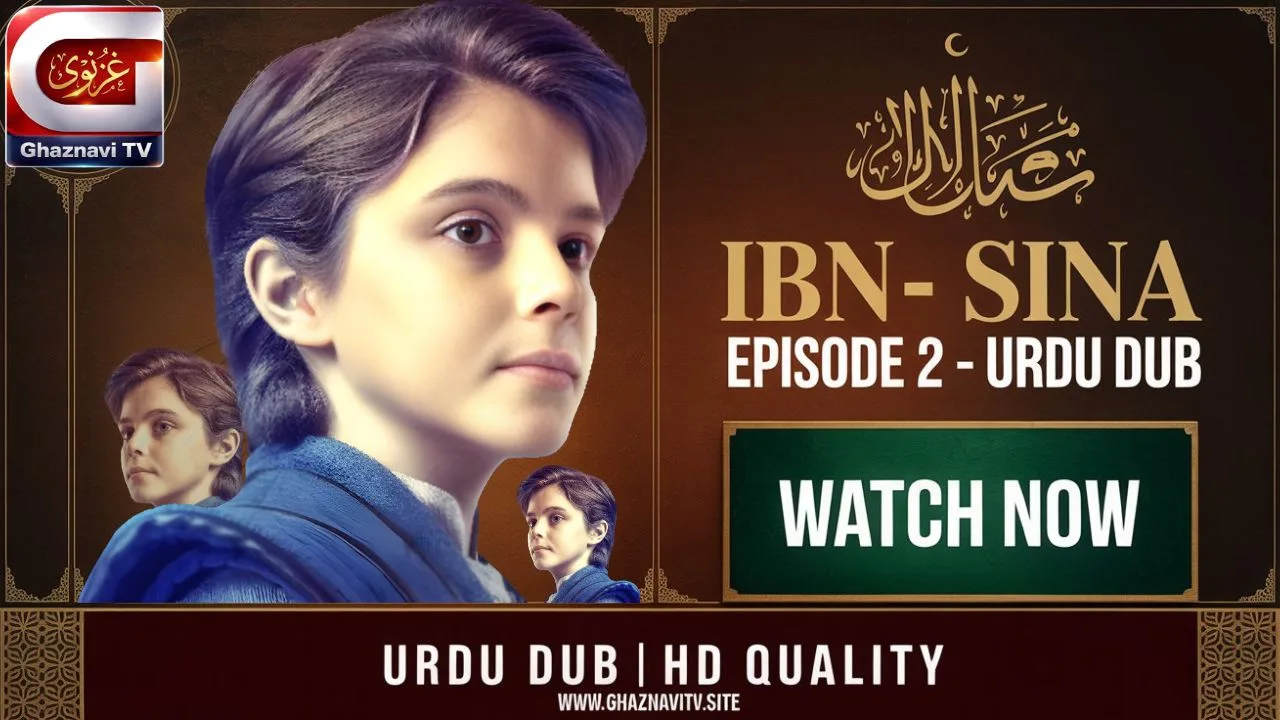

Ibn Sina Episode 2 Urdu Dub is now streaming free on Ghaznavi TV. This episode quietly does something remarkable — it takes you back eleven centuries to a small home in Bukhara and introduces you to a child who looks at the world and cannot stop asking why. Not because he was taught to. Simply because that is how his mind works. And watching it happen is one of the most genuinely beautiful things this series offers.
Why Ibn Sina Episode 2 Urdu Dub Feels Like Watching History Come Alive
Ibn Sina Episode 2 Urdu Dub belongs to a kind of storytelling that is genuinely rare — the kind that makes you feel the weight and wonder of a real life without ever feeling like a history lesson. The series Ibn-i Sina: The Young Genius, released in May 2023, transports viewers to 11th-century Bukhara with a visual care and emotional warmth that very few historical productions manage to sustain across multiple episodes. Episode 2 confirms that the first episode was not a fluke.
What sets this show apart from most historical dramas is its decision to focus not on the legendary achievements of Ibn Sina the adult physician and philosopher, but on the early years that shaped him. Episode 2 sits inside that childhood with patience and love — watching a boy who has not yet saved a single life but is already learning to notice things that others do not. That quiet noticing is where everything begins.
Watch Ibn Sina Episode 2 Urdu Dub

A Series That Trusts Its Young Audience
One of the most refreshing qualities of Ibn Sina Episode 2 Urdu Dub is the way it trusts its audience — including younger viewers — to engage with ideas rather than just action. The episode does not simplify young Sina’s intelligence into easy tricks or dramatic moments of genius. Instead, it shows thinking as a process: slow, careful, sometimes confused, and always deeply curious.
For parents watching with their children on Ghaznavi TV, this creates exactly the kind of viewing experience that stays with a child long after the episode ends. The message is not just that Ibn Sina was brilliant. It is that curiosity, patience, and the habit of asking real questions are things every child can practice — and that these habits, nurtured over time, can lead somewhere extraordinary.
Why the Urdu Dub Makes This Series Especially Accessible
The Urdu dubbing of this series is not simply a language substitution. It brings the story into a cultural and linguistic space that feels genuinely close to the audiences of Pakistan and South Asia — communities for whom Ibn Sina is not just a historical figure but part of a shared heritage of Islamic scholarship and scientific achievement. Hearing his story told in Urdu adds a layer of ownership and familiarity that subtitles alone cannot fully provide.
A Child Who Sees What Everyone Else Simply Walks Past
The central gift that Episode 2 of Ibn Sina Urdu Dub offers viewers is a window into how a truly extraordinary mind actually works — not as a series of dramatic aha moments, but as a continuous, quiet engagement with the world that never really switches off. Young Sina does not occasionally notice things. He is always noticing things. And the things he notices are the ones that most people around him have stopped seeing precisely because they are so ordinary.
A plant growing in an unusual direction. The way a sick person holds their body differently from a healthy one. The pattern of how a particular weather condition affects the people in his neighborhood. These are not dramatic clues in a detective story. They are the texture of everyday life — and Sina moves through that texture with an attention that is almost meditative in its steadiness.
Observation as the Foundation of Everything He Will Become
What Episode 2 understands, and communicates beautifully, is that Ibn Sina’s later greatness as a physician and philosopher was built on this early habit of careful observation. The Canon of Medicine — the medical encyclopedia he would eventually write that shaped medical education for centuries — was not the product of sudden inspiration. It was the accumulation of a lifetime of exactly this kind of watching, questioning, and connecting.
Episode 2 shows us that accumulation beginning. Not dramatically. Not with fanfare. Just quietly, day by day, in the streets and gardens and rooms of Bukhara, a child is building the knowledge base that history will eventually call revolutionary.
The Difference Between Looking and Actually Seeing
One of the episode’s gentlest and most important insights is the distinction it draws between simply looking at something and actually seeing it. Most of the adults around young Sina look at the same world he does — the same plants, the same people, the same patterns. But they have stopped asking questions about what they see. They have accepted the surface of things as the complete reality.
Sina has not yet learned that particular form of intellectual surrender. And Episode 2 celebrates that fact without ever making it feel like a criticism of the people around him. His curiosity is not presented as superiority. It is presented as a gift — one that carries its own weight and its own loneliness.
What This Teaches Young Viewers About Their Own Curiosity
For children watching Ibn Sina Episode 2 Urdu Dub on Ghaznavi TV, this aspect of the episode carries a quiet but powerful message: the questions you ask about the world around you are not interruptions or distractions. They are the beginning of understanding. Sina did not become great despite his endless questions. He became great because of them.
The Questions That Set Him Apart From Every Other Child in Bukhara
If there is one thing that defines young Sina in Ibn Sina Episode 2 Urdu Dub, it is the specific quality of the questions he asks. Not just their frequency — though he does ask constantly — but their nature. He does not ask questions to fill silence or to be noticed. He asks them because he genuinely cannot move forward without an answer. The not-knowing sits uncomfortably inside him until he resolves it.
This is a very specific kind of intellectual drive — not the performance of intelligence, but the genuine discomfort of an unsatisfied mind. And it is this drive, more than any natural gift, that the episode identifies as the true source of what Sina will eventually become.
Questions About Illness That Doctors Had Not Yet Answered
Even at this early age, some of Sina’s most persistent questions are about sickness — why certain people get ill when others in the same household do not, what the body is actually doing when it develops a fever, whether there is a pattern to how diseases move through a community. These are not childlike questions in the way we usually use that phrase. They are the questions that would eventually drive the development of modern epidemiology and clinical medicine.
Episode 2 plants these questions gently and naturally — not as a preview of future greatness, but as the honest expression of a child trying to make sense of something he has seen and cannot stop thinking about. That naturalness is one of the episode’s greatest strengths.

The Social Cost of Being Endlessly Curious
Episode 2 also touches, with sensitivity and without overdramatizing, on something real about what it is like to be a child whose mind works differently from most of the children around them. There are moments of loneliness in young Sina’s curiosity — moments when he is so absorbed in observing or thinking that he exists slightly outside the ordinary flow of childhood around him.
The series does not turn this into a tragedy. But it does acknowledge it honestly — because pretending that extraordinary intelligence comes without any social complications would be a kind of dishonesty about what the life of a genuinely unusual child actually feels like.
How His Questions Evolve Between Episodes 1 and 2
Viewers who watched Episode 1 will notice in Ibn Sina Episode 2 Urdu Dub that his questions have already become more sophisticated. Where Episode 1 showed him asking what and how, Episode 2 begins introducing the deeper question: why. That shift — from description to cause — is the intellectual step that separates observation from true understanding. And it is exactly the step that the historical Ibn Sina would spend his entire life pursuing.
The Teachers Who Try to Keep Up With Him
One of the most quietly charming elements of Ibn Sina Episode 2 Urdu Dub is watching the various mentors and scholars in young Sina’s life encounter the specific challenge of teaching a student who frequently surprises them. These are not incompetent teachers. They are learned men — physicians, philosophers, scholars of the Quran and logic — who have dedicated their lives to knowledge. And then they meet this child.
The moment when a teacher pauses mid-explanation because his young student has just offered an observation that he himself had not considered — that moment is shown in Episode 2 with a warmth that avoids making anyone look foolish. The teachers are not diminished by Sina’s questions. If anything, they are shown as exactly the kind of open-minded scholars who recognize genuine potential when it sits in front of them and respond to it with humility and encouragement.
The Relationship Between Student and Teacher in 11th-Century Bukhara
Episode 2 gives viewers a genuinely beautiful picture of what education looked like in the golden age of Islamic civilization — a world where learning was considered one of the highest human activities, where teachers were deeply respected, and where the transmission of knowledge from one generation to the next was understood as both a religious obligation and a profound human gift.
Young Sina enters this world with complete seriousness. He does not treat his education as something that happens to him. He pursues it actively, prepares carefully, and brings to every lesson the same intensity of attention that he brings to everything else in his life. His teachers recognize this — and they respond to it by giving him more than the standard curriculum could contain.
When the Student’s Questions Push Beyond the Teacher’s Answers
There is a particular kind of scene in Episode 2 that will stay with thoughtful viewers long after the episode ends — the moment when Sina asks a question that his teacher cannot fully answer. Not because the teacher is not knowledgeable, but because the question reaches into territory that the knowledge of the time has not yet mapped.
The teacher’s response to this moment — his choice to acknowledge the limit of his own knowledge honestly rather than deflecting or dismissing the question — is one of the episode’s most important character moments. It shows a tradition of learning that valued truth over ego. And it shows young Sina that the frontier of knowledge is a real place — one that he might someday help to extend.
How These Early Teachers Shape the Man Ibn Sina Will Become
The mentors in Episode 2 are not just background characters. They are formative influences — people who show Sina not just what to know but how to think, how to question, how to hold uncertainty without letting it stop you from moving forward. Their influence on him is not dramatic. It is cumulative — one lesson, one conversation, one honest acknowledgment of a limit at a time. That quiet accumulation is exactly how real education works.
What Young Sina Is Already Beginning to Understand
Episode 2 of Ibn Sina Urdu Dub gives viewers a clear picture of the range of subjects that are already beginning to capture young Sina’s attention — and the breadth of that range is itself remarkable. He is not a specialist at this age. He is a gatherer — collecting knowledge from every direction, looking for the connections between things that most people study in complete isolation from each other.
The Human Body – A Mystery He Cannot Stop Thinking About
Even in Episode 2, young Sina’s fascination with the human body is already visible and already unusually sophisticated. He is not simply curious about illness in the way that a child who has been sick might be. He is curious about the body as a system — how its different parts relate to each other, why imbalances in one area seem to produce effects in completely different areas, and what the body is actually trying to do when it produces symptoms that most people simply experience as suffering.
These are the questions that will eventually drive the Canon of Medicine — one of the most influential medical texts in human history. Episode 2 shows their earliest seeds being planted.
Natural Remedies and the Wisdom of Plants
Alongside his interest in the human body, young Sina in Episode 2 demonstrates a growing fascination with the natural world — specifically with the plants, herbs, and natural substances that the physicians and healers around him use in their treatments. He is not content to know that a particular herb helps with a particular condition. He wants to know why. What is in the plant? How does it interact with the body? Are there patterns in which plants help with which types of illness?
These questions place him, even at this age, at the intersection of botany, chemistry, and medicine — a position that the historical Ibn Sina would eventually occupy at the very highest level of human knowledge.
Logic and Moral Reasoning – The Framework for Everything Else
What makes young Sina’s intellectual development in Episode 2 particularly compelling is that his interest in science and medicine does not exist in isolation from his interest in philosophy, logic, and moral reasoning. He understands — perhaps instinctively, perhaps through his early education — that good thinking requires a framework. That observation without a logical structure for interpreting what you observe produces confusion rather than knowledge.
His engagement with logic in Episode 2 is shown as genuinely exciting to him — not as dry academic exercise but as the discovery of a tool that makes everything else he is curious about more accessible and more reliable.
The Integration of Knowledge That Defines Ibn Sina’s Legacy
What history eventually recognized in Ibn Sina — and what Ibn Sina Episode 2 Urdu Dub begins to show in its earliest form — is that his greatest contribution was not any single discovery but his ability to integrate knowledge across disciplines in a way that created entirely new understanding. Episode 2 plants the seeds of that integration with quiet, intelligent care.
The Family Behind the Genius – Where the Real Story Lives
If the intellectual storyline of Ibn Sina Episode 2 Urdu Dub is compelling, the family storyline is where the episode finds its warmth — and its heart. Because behind every extraordinary mind in history, there has always been a set of ordinary human relationships that shaped it. Episode 2 gives those relationships the attention and honesty they deserve.
Young Sina’s home life is not perfect. His parents are not always sure what to make of a child whose mind moves faster than most of the adults around them. There are moments of confusion, moments of gentle conflict, and moments of a love that does not fully understand what it is nurturing but nurtures it anyway. That combination — love without complete understanding — is one of the most human things Episode 2 depicts.
His Mother’s Quiet Strength – The Support That Needs No Words
Sina’s mother in Ibn Sina Episode 2 Urdu Dub is not a dramatic character in the conventional sense. She does not make grand speeches or take bold actions. What she does — consistently, quietly, and with a love that is completely without condition — is create a home environment in which her son feels safe enough to be exactly who he is.
For a child as unusual as young Sina, that safety is not a small thing. It is foundational. The freedom to ask endless questions, to disappear into thought, to care about things that most children his age do not care about — these freedoms exist because his mother allows them. Because she has decided, without necessarily understanding where they will lead, that who her son is matters more than who she expected him to be.
What Her Support Actually Looks Like Day to Day
Episode 2 shows her support not through declarations but through small, consistent acts. She brings him food when he has forgotten to eat because he was absorbed in something. She answers his questions with patience even when she does not have real answers. She watches him with a mixture of pride and gentle worry that any parent of an unusual child will recognize immediately.
These moments are the emotional core of the episode. They remind viewers that the history of knowledge is not just a story about ideas. It is a story about the people who loved the people who had the ideas — and who made space for those ideas to grow.
The Mother as an Unwritten Chapter of Islamic History
The historical record tells us relatively little about Ibn Sina’s mother. But the series makes a thoughtful and meaningful choice to honor her presence in his formation. Behind every child who changes the world, there is a parent who chose — often at personal cost and without any certainty about the outcome — to trust what they saw in their child and support it anyway. Episode 2 gives that choice the recognition it deserves.
His Father’s Thoughtful Wisdom – The Questions Behind the Questions
If Sina’s mother provides the emotional safety of his home, his father provides something different but equally essential in Ibn Sina Episode 2 Urdu Dub — intellectual companionship. His father is a man of learning himself, and he recognizes in his son something that goes beyond ordinary childhood curiosity. He does not simply answer Sina’s questions. He asks questions in return — questions that push Sina to think harder, go deeper, and develop the habit of examining his own reasoning rather than just his observations.
This kind of parenting — challenging without discouraging, demanding without pressuring — is one of the more nuanced things Episode 2 depicts. The father’s approach to his son is neither simple indulgence nor rigid discipline. It is something more thoughtful: the deliberate cultivation of a mind he can already see is exceptional.
The Moments When He Struggles to Understand His Own Child
Episode 2 also allows the father to be human in his limitations. There are moments where Sina goes somewhere intellectually that his father cannot fully follow — not because his father is not intelligent, but because his son is operating at a level that has genuinely moved beyond what the father’s own education prepared him for. These moments are shown without drama and without diminishing the father. They are simply honest.
And his response to these moments — choosing encouragement over defensiveness, choosing to find better teachers rather than pretending his own knowledge is sufficient — reveals a character of quiet greatness in its own right. He may not be able to follow his son everywhere his mind goes. But he can make sure the path is clear.
A Father’s Love That Looks Like Investment
In many historical dramas, father-child relationships are reduced to conflict or to idealization. Episode 2 avoids both. Sina’s father loves his son in a specific and realistic way — a way that expresses itself through attention, through careful guidance, through the willingness to be genuinely present with a child who is sometimes difficult to be present with. That specificity makes the relationship feel completely real.
The Early Glimpses of a Future That History Already Knows
One of the unique pleasures of watching Ibn Sina Episode 2 Urdu Dub is the double vision it creates — the ability to watch a child simply being a child, while simultaneously knowing where that child is going. History has already told us the destination. Episode 2 gives us the beginning of the journey — and the beginning is far more human, far more tentative, and far more touching than the legendary endpoint might suggest.
We see Sina beginning to identify patterns in illness that he cannot yet fully explain but cannot stop noticing. We see him solving problems that confuse the adults around him — not because he is smarter in some innate, unteachable way, but because he has been paying attention to things that others stopped paying attention to a long time ago. These early victories are small. But they are real. And they are building something.
Medicine Begins With Noticing – And He Has Already Started
The historical Ibn Sina memorized the Quran by age ten and had largely completed his study of philosophy by sixteen. By twenty-one, he had written his first major medical text. These are astonishing facts — but Episode 2 helps us understand them by showing us the much less astonishing but equally important foundation beneath them: a child who genuinely could not stop paying attention to the world around him.
His early observations about illness in Episode 2 are not correct in the way that a trained physician’s observations would be correct. They are the observations of a child — imperfect, sometimes misdirected, always earnest. But the habit of making them — the discipline of watching, recording mentally, looking for patterns, asking why — is exactly right. And it is already fully formed.
A Childhood That Does Not Rush Itself
What the series gets genuinely right — and what Episode 2 demonstrates with particular grace — is its refusal to rush young Sina’s development for dramatic effect. He is a child. He plays. He makes mistakes. He gets confused. He has days when the questions dry up and he simply exists in his ordinary life without turning everything into a puzzle.
This restraint is a gift. It allows the audience to love him not as a historical monument but as a person — a specific, real, wonderfully unusual person who happened to grow up into someone who changed the world.
Why This Series Matters for Muslim Children Everywhere
For Muslim children watching Ibn Sina Episode 2 Urdu Dub on Ghaznavi TV, this series offers something genuinely valuable — a hero from their own history who achieved greatness not through warfare or political power but through the love of knowledge and the disciplined pursuit of understanding. Ibn Sina is proof that the Islamic civilization’s golden age was real, was rich, and was built by people who looked like them, prayed like them, and spoke languages related to their own. That connection matters. And this series makes it beautifully accessible.
Watch Ibn Sina Episode 2 Urdu Dub Free on Ghaznavi TV
Ibn Sina Episode 2 Urdu Dub is available right now — completely free — on Ghaznavi TV at www.ghaznavitv.site. HD quality streaming with clear Urdu dubbing that brings the story of young Sina directly into your home in the language that feels closest to your heart.
Whether you are watching with your children, your family, or on your own as someone who loves Islamic history and inspiring storytelling — this series is made for you. And it is waiting, completely free, whenever you are ready.
🌐 Watch Free Now: www.ghaznavitv.site | Ibn Sina Episode 2 Urdu Dub | All Episodes | HD Quality | Free
What happens in Ibn Sina Episode 2 Urdu Dub?
Episode 2 continues the story of young Sina in 11th-century Bukhara, deepening our understanding of how his extraordinary mind works. The episode follows his growing curiosity about illness, nature, and logic — his interactions with teachers who are frequently stunned by his observations — and the warm family life that provides the emotional foundation for everything he is becoming.
Where can I watch Ibn Sina Episode 2 Urdu Dub for free?
Watch it completely free on Ghaznavi TV at www.ghaznavitv.site. HD quality Urdu dubbing, smooth streaming on any device — no registration or payment required.
Is Ibn Sina suitable for children to watch?
Absolutely. Ibn-i Sina: The Young Genius is one of the best educational series available for children interested in Islamic history, science, and inspiring role models. Episode 2 contains no violence or inappropriate content — it is warm, intelligent, and genuinely suitable for viewers of all ages, with particular appeal for children aged 8 and above.
Who was Ibn Sina in real history?
Ibn Sina — known in the West as Avicenna — was born around 980 CE in Bukhara (in present-day Uzbekistan). He became one of the greatest physicians, philosophers, and scientists of the medieval world. His Canon of Medicine was used as a standard medical textbook in Europe and the Islamic world for over six centuries. He is widely considered the father of early modern medicine. For more historical detail, Britannica’s article on Avicenna is an excellent resource.
What subjects does young Sina study in Episode 2?
Episode 2 shows young Sina engaging with the structure and behavior of the human body, natural remedies and herbal medicine, scientific patterns in everyday life, and logical and moral reasoning. His interests span what we would today call medicine, biology, botany, philosophy, and epidemiology — all approached with a child’s curiosity and an extraordinary mind’s depth.
( Ibn Sina Episode 2 Urdu Dub)
How does the Urdu dub compare to watching with subtitles?
The Urdu dubbing on Ghaznavi TV brings an additional layer of cultural and linguistic familiarity to the story. For South Asian audiences — particularly families watching with children who may find reading subtitles difficult — the Urdu dub makes the story fully immersive and accessible in a way that subtitles alone cannot achieve. The dubbing quality is clear and well-matched to the emotional tone of the original performances.
Ibn Sina Episode 2 Urdu Dub
Does Episode 2 continue directly from Episode 1?
Yes. Episode 2 picks up the story of young Sina directly from where Episode 1 left off, continuing his early childhood in Bukhara and deepening the character development, family dynamics, and intellectual curiosity that Episode 1 introduced. Watching both episodes in sequence gives the richest understanding of who he is and where he is heading.
Ibn Sina Episode 2 Urdu Dub
Table of Contents
Ibn Sina Episode 2 Urdu Dub
Ibn Sina Episode 2 Urdu Dub
- Ibn Sina Episode 9 Urdu Dubbed – One Episode From the End and the Boy Has Become Someone Remarkable
- Sultan Muhammad Fateh Episode 84 Urdu Subtitles – Season 4 Opens and the Real Work of an Empire Begins
- Ibn Sina Episode 8 Urdu Dubbed – Two Episodes From the End and Everything Is at Stake
- Ibn Sina Episode 7 Urdu Dubbed – Three Episodes From the End and the Story Is at Its Most Alive
- Ibn Sina Episode 6 Urdu Dubbed – The Second Half Begins and the Story Has Never Been Deeper
Ibn Sina Episode 2 Urdu Dub
Ibn Sina Episode 2 Urdu Dub
Ibn Sina Episode 2 Urdu Dub
Ibn Sina Episode 2 Urdu Dub



[…] Join WhatsApp ▶ Watch Episode 2 […]
[…] Join WhatsApp ▶ Watch Episode 2 […]